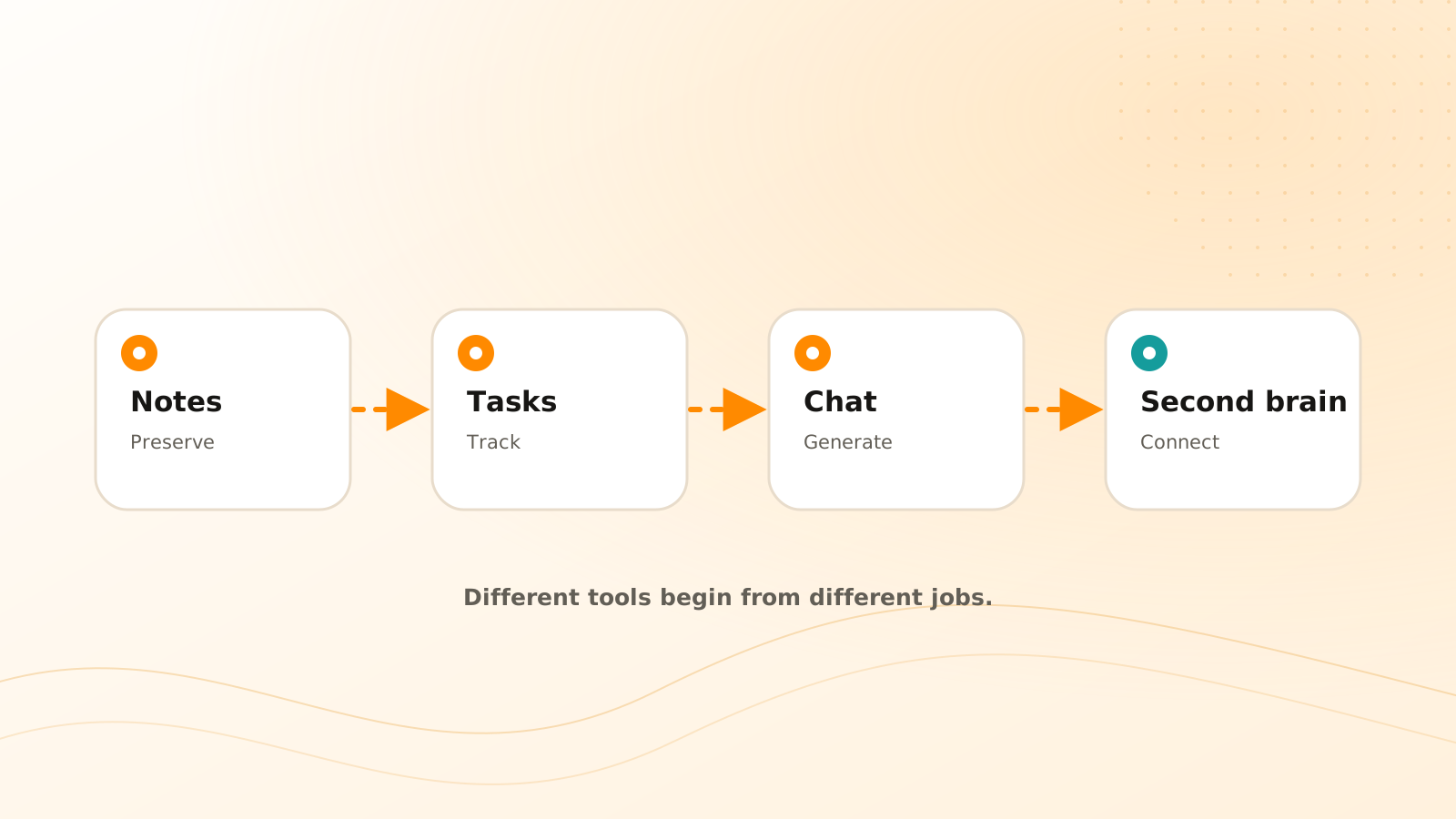
You may not need an AI second brain. If your problem is writing a few documents, a note app may be enough. If your problem is remembering deadlines, use a task manager. If you need help drafting or exploring a question, a general chatbot may solve it.
An AI second brain becomes useful when those needs repeatedly cross boundaries: a message becomes a task, a meeting creates a decision, a source informs a page, and future work depends on recovering the connection.
What does each tool optimize for?
Note apps
Note apps optimize for creating, organizing, and retrieving written material. They are strong for documents, research, journals, and maintained reference. Their usefulness depends on how consistently you capture and structure the information.
Task managers
Task managers optimize for commitments: actions, owners, status, dates, priorities, and recurring work. They are strong at answering what needs to happen, but the source and reasoning behind a task may live elsewhere.
General chatbots
General chatbots optimize for conversational generation and reasoning within the context available to the conversation. They can explain, draft, transform, and explore, but they do not automatically provide a maintained record of your projects and sources.
AI second brains
An AI second brain connects capture, structured knowledge, retrieval, durable context, and action. Its value is not that it replaces every specialist tool. It reduces the reconstruction required when work moves among them.
Clear Tangle is one concrete implementation of that connected model: Captures and integrations preserve incoming context, Projects and Pages organize active knowledge, Tasks track commitments, Search and ChatMind retrieve it, and Memory Vault carries scoped context forward. Integration Intelligence and Agent Studio add review queues or approval gates when connected context may change work. You can test that loop without claiming every specialist app must disappear.
A practical comparison
| NEED | NOTE APP | TASK MANAGER | GENERAL CHATBOT | AI SECOND BRAIN |
|---|---|---|---|---|
| Preserve detailed source material | Strong | Limited | Conversation-dependent | Strong when source retention is designed in |
| Track owners, dates, and status | Limited | Strong | Can propose | Connected task model |
| Answer natural-language questions | Varies | Limited | Strong in supplied context | Strong when retrieval is grounded in your sources |
| Carry context across work | Manual links and structure | Task history | Product-dependent memory | Designed around connected knowledge and scoped memory |
| Turn evidence into reviewable action | Often manual | Action already structured | Can suggest | Connects retrieval, proposal, confirmation, and history |
These are general distinctions, not guarantees. Products in each category increasingly overlap. Evaluate the exact implementation, export options, privacy model, source visibility, and controls you intend to use.
When should you stay with simpler tools?
Use a simpler system when:
- your information already fits one well-maintained workspace;
- tasks rarely need external context;
- you do not need conversational retrieval;
- integration maintenance would cost more than manual work;
- you are unwilling to review AI interpretations;
- the material is too sensitive for the proposed system.
A connected system should remove repeated work, not create a permanent configuration project.
When does an AI second brain become useful?
It may help when:
- useful context arrives across notes, messages, meetings, and files;
- you remember meaning more often than exact filenames;
- tasks regularly lose the evidence that created them;
- the same project must be reconstructed across several tools;
- stable preferences and decisions need to influence future assistance;
- AI-generated actions require visible sources, review, and history.
The test is not how many features the product has. It is whether one connected loop—capture, organize, retrieve, act—works more reliably than your current handoffs.
How should you evaluate a second-brain product?
Run a real-work evaluation
Choose one recurring workflow
Use a meeting follow-up, research trail, or message-to-task process instead of importing everything.
Preserve the source
Confirm that derived tasks, answers, and memories still lead back to the original material.
Test imperfect recall
Search using remembered meaning and verify that results can be narrowed and inspected.
Review an AI suggestion
Check whether owners, dates, relationships, and uncertainty remain correctable.
Test boundaries
Inspect permissions, export, deletion, sensitive-data handling, and action history before expanding use.
Clear Tangle's core concepts describe how its captures, projects, pages, tasks, conversations, and memories fit together. If you are starting from scratch, the earlier minimal AI second-brain guide offers a smaller first loop.
Frequently asked questions
Can an AI second brain replace my task manager?
It may include task management, but replacement depends on the depth, integrations, and team workflows you need. Judge the real task model rather than the category label.
Is a chatbot with uploaded files a second brain?
It can provide conversational retrieval for those files. A broader second-brain system also maintains capture, organization, relationships, memory, tasks, sources, and ongoing workflow state.
Should I migrate all my notes immediately?
No. Test one active workflow first. Migrate or connect more material only after capture, retrieval, source verification, and action controls prove useful.
How is Clear Tangle different from using a chatbot beside my notes app?
Clear Tangle connects captures, projects, pages, tasks, memories, retrieval, and reviewable workflows in one knowledge model. A separate chatbot may help with supplied text but can leave those relationships and ongoing work state manual.
Can I adopt Clear Tangle without abandoning my current tools?
Yes. Start with one source or workflow and judge whether the connection preserves context and reduces repeated work. Expand only where the integrated path proves more useful than the existing handoff.
Choose the smallest system that reliably supports your work. An AI second brain earns its complexity only when the connections among knowledge, context, and action save more effort than they require.
Test one connected knowledge workflow
Explore how Clear Tangle combines captures, projects, pages, tasks, memories, search, and reviewable AI without requiring an all-at-once migration.
Explore the core concepts →Sources
- Clear Tangle Core Concepts — supports the current model of captures, projects, pages, tasks, conversations, and memories.
- Clear Tangle Features — supports the current product capability comparison described here.
- Personal Information Management — William Jones and co-authors; supports the broader framework of keeping, managing, and finding personal information for future use.