An AI agent demo is easy to make impressive: give a model broad tools, ask for an outcome, and hide the mistakes. A trustworthy workflow has a harder job. It must produce useful results repeatedly while making its scope, evidence, uncertainty, and consequences understandable.
Trust is not a personality trait of the model. It is a property of the entire workflow.
What is an AI agent workflow?
An agent workflow combines a model with context, instructions, and tools that can read or change external systems. It may search a knowledge base, prepare a plan, create tasks, update records, send messages, or run a defined multi-step process.
The ability to act introduces risks that ordinary text generation does not. The workflow may choose the wrong tool, repeat an operation, use stale context, cross a permission boundary, or complete a valid action for the wrong object.
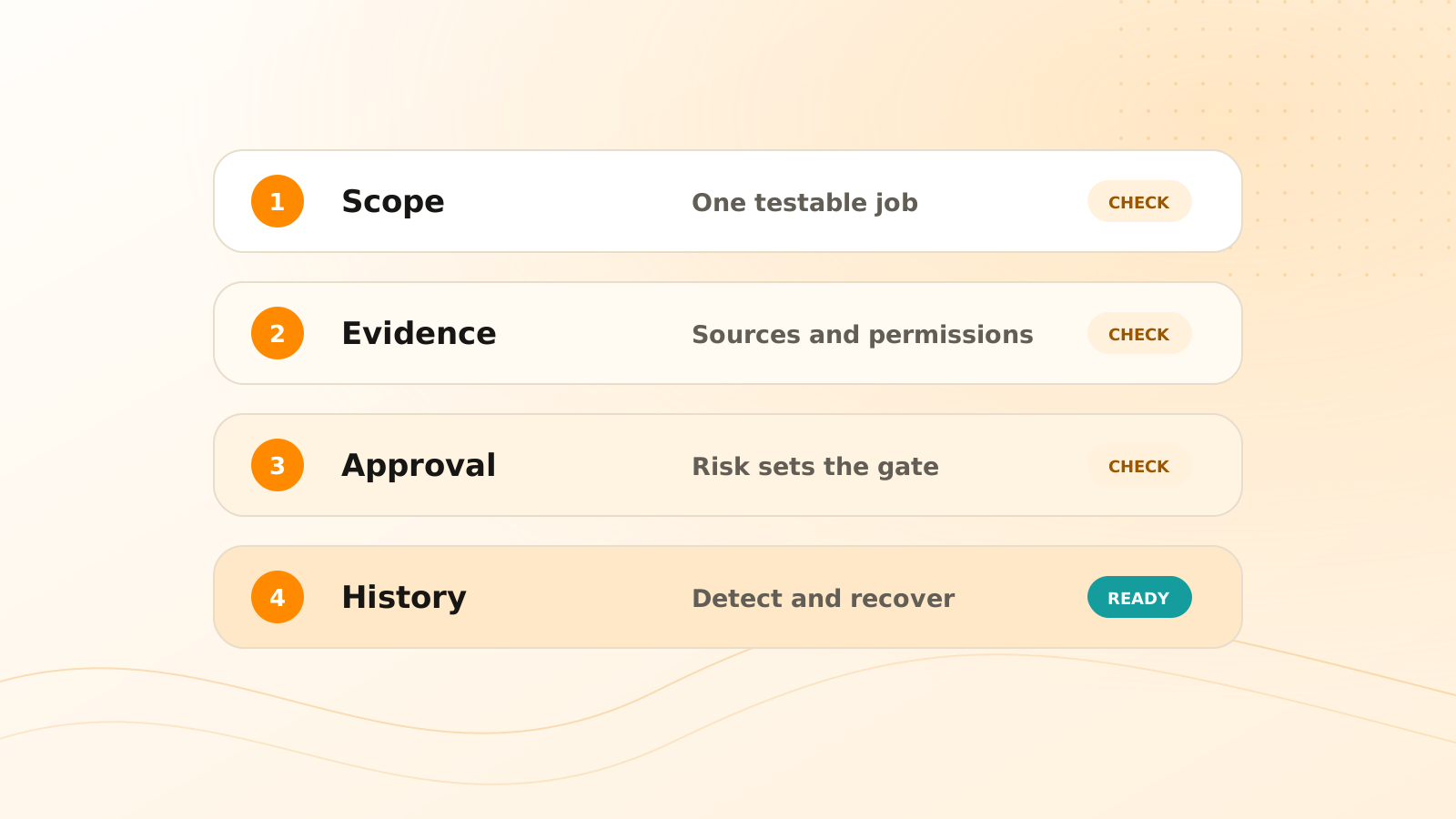
Seven properties of a trustworthy agent
1. A narrow, testable purpose
“Manage my work” is too broad. “Prepare proposed tasks from this meeting and wait for review” has a clear boundary and observable result.
That narrower pattern is how an Agent Studio workflow should begin in Clear Tangle: select only the tools and context the job needs, keep the first runs in a review queue, and use approval gates before higher-consequence operations. Action history then gives the reviewer a record of what the agent attempted and what actually changed.
2. Least-privilege tools
Give the workflow only the systems and operations required for its job. Read access does not imply write access; task creation does not imply deletion; one project does not imply every project.
3. Source-grounded decisions
Important claims and proposed actions should point to the material that supports them. When the evidence is missing or contradictory, the agent should expose the gap.
4. Risk-based confirmation
Not every step needs a dialog. Reading a page and proposing a tag are lower risk than sending a message, closing a task, changing production, or spending money. Confirmation should increase with consequence and ambiguity.
5. Safe execution semantics
Retries must not create duplicate tasks, send repeated messages, or apply the same charge twice. Operations should use stable identifiers, idempotency where supported, and checks against current state.
6. Visible action history
Record what the workflow attempted, which tool it used, what changed, and whether the result was confirmed. Logs should support diagnosis without exposing unnecessary sensitive content.
7. Correction and rollback
The user needs a practical way to edit a proposal, reject an action, undo a reversible change, or restore state. For irreversible operations, the workflow should stop earlier and demand stronger confirmation.
How do you review an agent before using it?
A preflight for agent workflows
Define the allowed outcome
State what the agent may produce and the conditions that mean it should stop or ask.
Inventory tools and permissions
Remove unrelated systems and separate read, propose, and execute capabilities.
Map failure consequences
Identify duplicate, destructive, external, sensitive, and cross-scope failure modes.
Add evidence and approval gates
Require source context and confirmation where ambiguity or consequence is high.
Test retries and stale state
Verify that repeated calls, changed records, timeouts, and partial failure do not corrupt work.
Inspect the audit trail
Confirm that a reviewer can understand what happened and correct it.
What should remain human-reviewed?
Human review is most valuable where values, authority, or irreversible consequences are involved. Examples include publishing, external communication, financial commitments, deleting records, assigning work to others, production changes, and decisions based on weak evidence.
Review should be designed, not ceremonial. Show the proposed change, supporting evidence, uncertainty, affected system, and available alternatives. A button labeled “approve” is not meaningful if the reviewer cannot understand the payload.
How do you measure trustworthiness?
Do not measure only whether the final answer looks good. Track:
- task or record mutation accuracy;
- duplicate and retry behavior;
- unsupported-claim rate;
- frequency and quality of clarification;
- permission denials and boundary violations;
- successful correction or rollback;
- user acceptance after informed review;
- failures by tool, source, and consequence level.
A workflow that asks more questions may be safer but unusably slow. One that never asks may be fast and dangerous. Test the full interaction, including how the user notices and repairs an error.
Clear Tangle's Agent Studio documentation describes the current tools, permissions, review queues, approval gates, and history model. The preceding voice-to-task workflow shows these controls in a concrete interaction.
Frequently asked questions
Is a more capable model automatically a more trustworthy agent?
No. Model capability can improve interpretation, but permissions, evidence, confirmation, execution design, monitoring, and recovery determine whether the complete workflow is trustworthy.
Should every agent action require approval?
No. Match the control to the risk. Low-consequence, reversible enrichment can be automatic; external, destructive, sensitive, or ambiguous actions deserve stronger review.
What is the safest first agent workflow?
Begin with a read-only or proposal-only job that has a narrow scope and verifiable output. Add execution only after its retrieval, reasoning, and failure behavior are understood.
How does Clear Tangle Agent Studio support human review?
Its documented model includes scoped tools and permissions, review queues, approval gates, and action history. Those controls help a person inspect evidence and consequences before expanding an agent's authority.
What should I test before allowing an agent to write data?
Test source selection, ambiguous instructions, permission denial, duplicate retries, stale state, partial failure, and correction. A good answer in the happy path is not enough evidence for mutation access.
A trustworthy agent is not one that never fails. It is one whose boundaries reduce predictable harm, whose evidence lets people evaluate it, and whose failures can be detected and corrected before they compound.
Build agents with visible boundaries
Use Clear Tangle Agent Studio to create focused workflows with scoped tools, review queues, approval gates, and action history.
Explore Agent Studio →Sources
- Clear Tangle Agent Studio Documentation — supports the current agent tools, review queues, approval gates, and action-history capabilities.
- NIST AI Risk Management Framework — National Institute of Standards and Technology; supports a risk-management approach to trustworthy and responsible AI systems.
- Artificial Intelligence Risk Management Framework Generative Artificial Intelligence Profile — National Institute of Standards and Technology; supports attention to generative AI risks, information integrity, monitoring, and human oversight.