A second brain becomes less useful when it is treated as a destination for everything. The archive grows, search results become noisy, and durable memory fills with details that were only relevant for an afternoon.
The better question is not “Can I save this?” It is “What future need would make this worth keeping?”
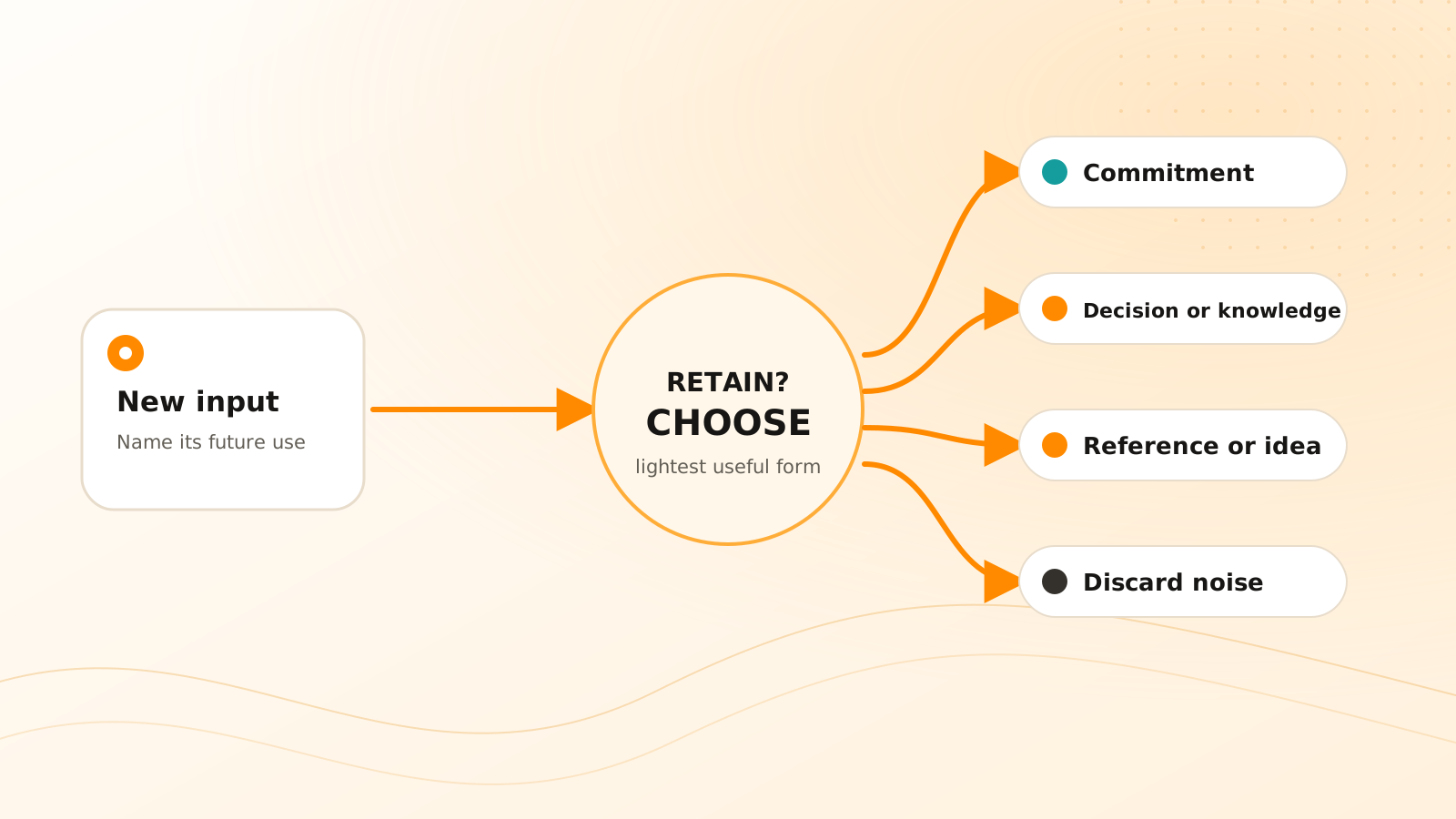
Information belongs in a second brain when you expect to retrieve it, reuse it, verify it, or act on it later. That future use determines whether the item should remain a raw capture, become a task, support a project, live as maintained knowledge, or be promoted into durable memory.
What are the five useful kinds of information?
Most valuable inputs fall into five practical groups.
Clear Tangle represents those groups with distinct but connected objects. Captures preserve incoming material, Tasks hold commitments, Projects connect active outcomes, Pages maintain reusable knowledge, and AI Memories or Memory Vault carry carefully scoped context forward. You can keep the source record even when its useful conclusion moves into one of those structures.
Commitments
A commitment is something a person or system is expected to do. It belongs in the system because forgetting it has a consequence.
Capture the action, its owner when known, the source of the commitment, and any explicit timing. Do not manufacture a due date merely to make the record look complete. A commitment normally becomes a task, while the original message or meeting remains the evidence behind it.
Decisions
A decision records what was chosen and enough reasoning to understand the choice later. Decisions are especially valuable because teams often remember the outcome but forget the constraint that produced it.
Preserve the date, scope, alternatives considered when material, and the source. Connect the decision to its project. Stable decisions may also belong in durable project memory so future planning does not reopen settled questions without new evidence.
Reusable knowledge
Reusable knowledge includes an explanation, procedure, research conclusion, troubleshooting note, or pattern that will help more than once.
Raw captures are rarely the best final form. Turn the useful conclusion into a page or maintained note. Keep citations and links where the conclusion depends on external evidence.
References
A reference is an artifact you expect to consult: a contract, specification, design, paper, policy, or source document. The goal is not to rewrite it immediately. The goal is to keep it findable and connected to the work it informs.
Add enough context to answer: Why did I save this? Which project or decision does it support? Is this the canonical version?
Ideas
An idea can be worth keeping before it is actionable. Save the observation, the problem it might solve, and the situation that triggered it. That context makes later evaluation more useful than a title such as “great app idea.”
Ideas do not all need projects or tasks. Promote them only when you deliberately choose to explore them.
What should usually stay out?
Do not keep material that has no plausible future use, is already available from a clear canonical source, or creates more risk than value.
Common examples include:
- routine notifications after the event is complete;
- duplicated files with no version distinction;
- unverified interpretations presented as facts;
- copied material without enough context to identify its source;
- temporary access codes or secrets;
- sensitive personal or client information that you are not authorized to store;
- every intermediate AI response from an exploratory conversation.
Deletion is part of knowledge management. Removing noise protects retrieval quality and reduces the chance that stale context will influence a later answer.
Should you capture a link or the conclusion?
Capture both when the conclusion matters.
A bare link is easy to save and hard to evaluate later. Add one sentence explaining why the source mattered and what question it helped answer. If you derive a conclusion, keep that interpretation separate from the source's factual content.
For example:
Source: vendor API deprecation notice. Interpretation: our mobile client may need a migration before the November release. Next action: confirm affected endpoints with engineering.
This structure makes fact, interpretation, and action distinguishable. If the source changes, you can revisit the conclusion rather than treating it as timeless truth.
When should a capture become memory?
Memory should be reserved for context that is stable enough to help future work without repeatedly reopening the original item.
Use four tests:
- 1Durability: Is this likely to remain true beyond the current session?
- 2Scope: Does it apply to you generally or only to one project?
- 3Evidence: Is it a confirmed fact, decision, or preference rather than a guess?
- 4Usefulness: Will future retrieval, planning, or communication improve because this is available?
An accepted project naming convention may qualify. A tentative deadline mentioned once may not. A communication preference may belong in user memory; a client-specific constraint belongs in project memory.
Clear Tangle's Memory Vault separates user and project context so durable information can be reused with clearer scope. That does not make memory infallible. Review and correct it when the underlying reality changes.
A retention decision you can make in 30 seconds
Decide what happens next
Name the future use
Will you retrieve, reuse, verify, or act on this? If none applies, discard it.
Choose the lightest form
Keep it as a capture, reference, page, task, project context, or memory according to that use.
Preserve provenance
Record the original source and distinguish factual evidence from your interpretation.
Set a scope
Connect it to the relevant project, tag, person, or user context without adding unnecessary taxonomy.
The purpose of a second brain is not total recall. It is reliable access to the context that helps you think, decide, and follow through.
If saving is currently the hard part, begin with the capture-first workflow. If the whole system is new, use the minimal AI second-brain setup before expanding it.
Frequently asked questions
Should every meeting note go into a second brain?
Keep meetings that contain decisions, commitments, reusable context, or evidence you expect to revisit. Routine conversations with no future use can remain outside or be removed after review.
What is the difference between a Clear Tangle Capture and a Page?
A Capture preserves incoming material and its source. A Page is better for maintained knowledge—a conclusion, plan, procedure, or explanation you expect to update and reuse.
When should information become a Task?
Create a Task when the source contains a real action or commitment with a recognizable done state. Keep the source attached so the task retains its reason and evidence.
Should temporary project details become AI memory?
Usually not. Keep changing or uncertain details in project notes or captures; promote only stable, supported context whose future reuse is intentional and appropriately scoped.
How do I reduce clutter in an existing second brain?
Remove duplicates and expired logistics first, then separate active commitments, maintained knowledge, canonical references, and durable memory. Retain information according to future use rather than age or volume.
Keep what will become useful
Explore how Clear Tangle separates incoming captures, active projects, maintained knowledge, tasks, and durable memory.
Read the core concepts →Sources
- Personal Information Management — William Jones and co-authors; supports keeping information for anticipated need and organizing it around later retrieval and use.
- Clear Tangle Core Concepts — supports the distinctions among captures, projects, pages, tasks, tags, and memories.
- Memory Vault Documentation — supports the current product model for durable user and project context.