Most work does not arrive as a clean document. It arrives as a message you need to remember, a meeting decision that creates three tasks, a half-formed idea in a voice note, a useful email, a page of research, or a commitment buried in a long conversation.
The problem is not capturing one more note. The problem is preserving the connection between what happened, why it matters, where it belongs, and what should happen next.
Clear Tangle is built around that connection. It is an AI-powered personal knowledge system—often called an AI second brain—that brings scattered work into one place, organizes it into durable context, and helps you use that context without surrendering control of the final action.
What does “AI second brain” mean?
An AI second brain is a knowledge system that does more than store files. It should help you capture information with low friction, recover it when the original wording is forgotten, understand how ideas and work items relate, and turn relevant context into a useful next step.
For Clear Tangle, that means four connected stages:
- Capture: bring in notes, messages, meetings, files, and ideas.
- Organize: route that material into projects, pages, tags, tasks, and memory.
- Understand: retrieve relevant context through search, conversation, and relationships.
- Act: turn understanding into a prioritized task, a prepared workflow, or a supported action you can review.
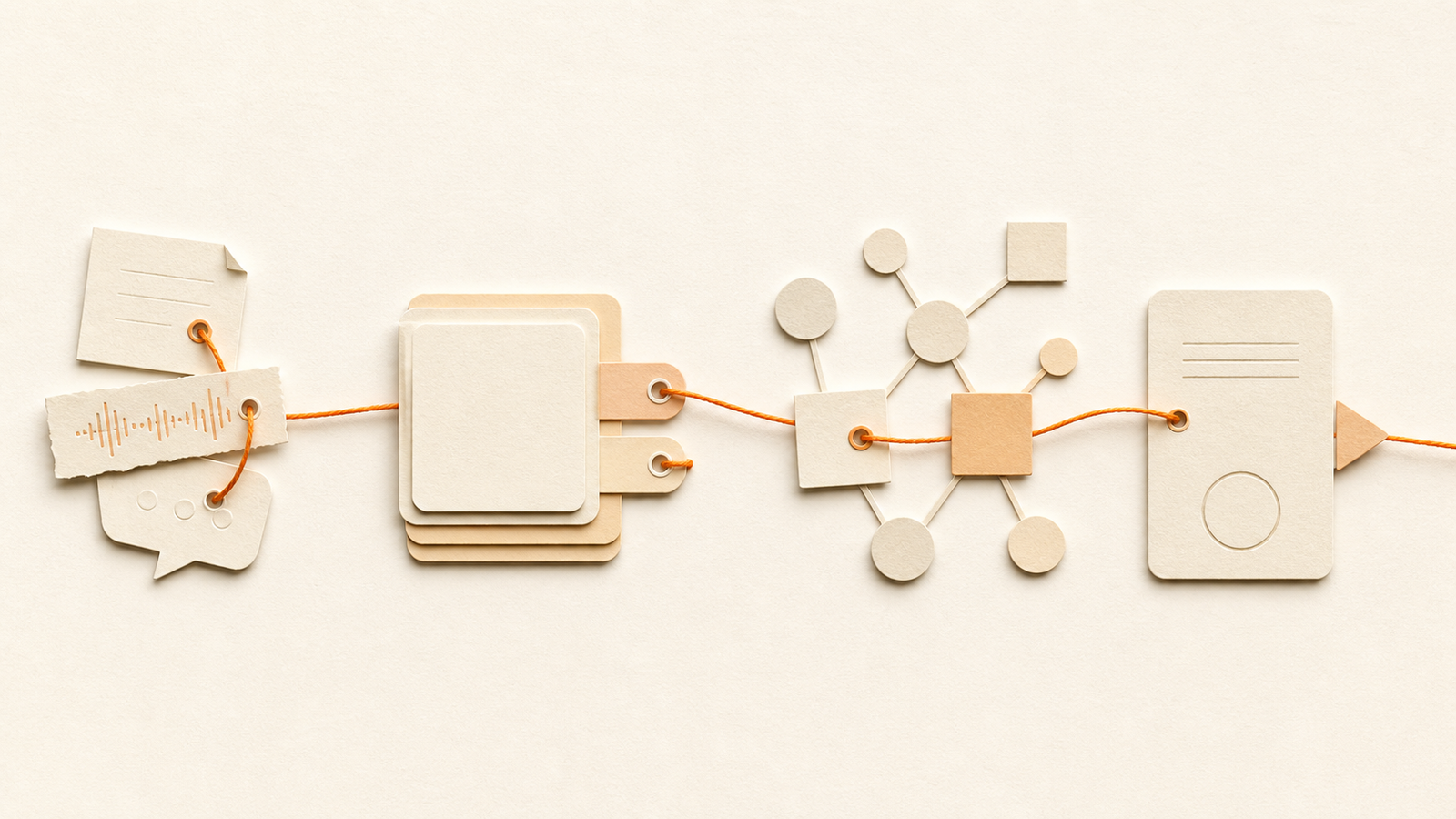
These stages are deliberately connected. A capture should not become another object you have to manually rediscover. A search result should retain its source. An AI answer should be more useful because it can draw from the context you have chosen to keep. An action should remain visible and reviewable rather than disappearing into an invisible automation.
Why ordinary notes and disconnected apps fall short
Notes are excellent at preserving what you wrote. Task managers are excellent at listing what you intend to do. Chat tools record conversations, calendars record time, and email records exchanges. The trouble begins when one piece of work spans all of them.
Imagine a client call that produces a decision, a follow-up email, two tasks, and an idea for later. In a disconnected setup, the transcript may live in a meeting tool, the decision in a document, the follow-up in email, the tasks in a separate list, and the idea nowhere reliable. You become the integration layer—copying, classifying, remembering, and reconstructing context every time the work resumes.
Clear Tangle is designed to reduce that reconstruction work. It keeps the original material close while building useful structure around it. The goal is not to replace every specialist tool. It is to provide a connected knowledge and action layer across the work those tools produce.
How Clear Tangle works
1. Capture work where it happens
A second brain is only useful if adding to it feels easier than deciding where every item belongs. Clear Tangle supports direct notes and quick captures, along with connected inputs such as Slack, Gmail, meeting tools, Google Calendar, Telegram, the command line, and desktop shortcuts.
You can begin with a sentence, a pasted passage, a file, or a voice-driven thought. The capture can then be analyzed for useful structure, including possible projects, tasks, tags, and memories. The original input remains important: derived context should help you work with the source, not erase it.
The practical difference is that you can record an idea while it is fresh and deal with its organization after capture. That is especially useful during meetings, research, deep work, or mobile moments when filing decisions would interrupt the thought itself.
Explore the maintained capture documentation for the current capture paths and workflow.
2. Organize information into a working system
Clear Tangle uses a small set of understandable building blocks:
- Inbox holds new material that still needs attention.
- Projects collect active outcomes and their relevant context.
- Pages preserve longer-form knowledge, decisions, and reference material.
- Tags create reusable connections across subjects and workstreams.
- Tasks convert commitments into trackable next actions.
- Memories preserve context worth carrying into future retrieval and conversations.
AI can help suggest or extract this structure, but organization is not treated as a mysterious one-time classification. You can review what was created, correct it, and keep the system aligned with how you actually work.
That matters because personal knowledge management is personal. A project name, client relationship, research topic, or decision can mean something specific in your world. Useful AI should adapt to that context without making the context impossible to inspect.
3. Understand what you know
Once information is connected, retrieval becomes more useful than searching for an exact phrase in the exact app.
Search helps you find captured material and structured knowledge. ChatMind provides a conversational way to work with relevant Clear Tangle context. Memory Vault keeps durable memory available for later use, while the knowledge graph exposes relationships among pages, captures, tags, and related material.
These are different views of the same underlying need: sometimes you remember a keyword, sometimes you remember the meaning, sometimes you need a concise answer, and sometimes you need to see how several pieces connect.
Source-linked retrieval is central to making those views useful. An answer is easier to evaluate when you can return to the material that supports it. Clear Tangle is intended to help you move from “I think we discussed this” to the relevant context, with enough provenance to check the conclusion yourself.
4. Turn context into action
Knowledge earns its place when it changes what you do next.
Clear Tangle connects knowledge to tasks, daily priorities, voice workflows, and Agent Studio. A meeting capture can surface a follow-up. A project can collect both reference material and open work. A conversation with ChatMind can help you retrieve the context behind a decision before you proceed.
Agent Studio extends that model into reusable AI workflows with supported tools. The important distinction is that “agentic” does not have to mean “unattended.” Where a workflow can create consequences, Clear Tangle can use scoped permissions, review queues, explicit confirmations, approval gates, and action history to keep the person in the loop.
In other words, the aim is not an AI that appears busy. It is an AI workflow that helps produce the right result and leaves enough evidence for you to understand what happened.
What can you use Clear Tangle for?
The system is broad enough for a personal knowledge base, but it becomes easiest to understand through concrete workflows.
Turn a meeting into durable work
Capture the meeting or bring in its output, retain the source, extract decisions and follow-ups, connect them to the right project, and create tasks you can review. When the project comes up again, the decision and the action remain connected.
Build a research trail you can revisit
Collect notes, source material, questions, and conclusions in pages and captures. Use tags and graph relationships to connect themes, then retrieve the relevant material through search or ChatMind without depending on one remembered filename.
Keep commitments from disappearing
Capture a promise from a message, email, or conversation; turn it into a task; and keep its origin close. The task records what needs doing while the source preserves why it exists.
Create reusable AI workflows with boundaries
Configure a focused agent around a defined job, give it only the supported tools and context it needs, and use review or approval controls for consequential steps. The workflow can become repeatable without becoming opaque.
Start the day from context, not from scratch
Use current projects, tasks, and captured context to orient around what deserves attention. Instead of rebuilding the day from several tabs, you can begin from the connected work already in the system.
What Clear Tangle is—and what it is not
Clear Tangle is a connected layer for personal knowledge, memory, tasks, retrieval, and reviewable AI workflows. It is designed for people who want information to remain useful after the moment of capture.
It is not a promise that AI can decide what matters without you. Automated analysis can be wrong. Integrations can bring in more information than is useful. A generated answer still deserves scrutiny when the stakes are high. Clear Tangle’s product direction treats sources, scope, confirmation, and history as practical controls—not as reasons to stop thinking.
It is also not necessary to connect every service on day one. A useful second brain can begin with one capture habit and one active project. The value grows as the material becomes connected and repeatedly retrievable.
Who is Clear Tangle for?
Clear Tangle is especially relevant to people whose work is context-heavy and distributed across tools:
- founders and operators moving among decisions, customers, projects, and follow-ups;
- developers and technical leaders tracking implementation context, research, and commitments;
- consultants and client-service professionals who need work history and next actions to stay connected;
- researchers, writers, and creators building a long-lived body of ideas and sources;
- anyone who has outgrown a folder of notes but does not want an autonomous system acting without review.
You do not need a perfect knowledge-management method before you begin. Clear Tangle is most useful when it reduces the maintenance burden of the system, not when it creates a new taxonomy project.
A simple way to begin
Your first Clear Tangle workflow
Capture one real piece of work
Add a meeting decision, research note, commitment, or idea that you expect to need again.
Connect it to an active outcome
Place it with the relevant project, page, tag, memory, or task; review any suggested structure before relying on it.
Retrieve and use it
Find the context through search or ChatMind, then turn the result into a clear next action you can verify.
This small loop is more revealing than importing an archive on the first day. It tests whether capture is easy, organization is understandable, retrieval is accurate enough to check, and action remains under your control. The quick-start guide walks through the current setup.
Frequently asked questions
Is Clear Tangle a note-taking app?
Clear Tangle includes notes and pages, but its scope is wider. It connects captured information to projects, tasks, memories, search, conversational retrieval, a knowledge graph, and reviewable AI workflows.
How is Clear Tangle different from a chatbot?
A general chatbot begins with the context placed in that conversation. Clear Tangle is designed to work with the personal knowledge and connected work you have chosen to capture, while preserving links back to relevant sources and structured items.
Does Clear Tangle act automatically?
Clear Tangle can support actions and reusable agent workflows, but consequential steps do not need to be invisible or unconditional. Current controls can include scoped permissions, review queues, explicit confirmations, approval gates, and action history.
Do I need to connect all my tools?
No. You can start with direct capture and one active project, then add integrations when they solve a real workflow problem. A smaller, trustworthy knowledge base is more useful than a large collection you do not revisit.
Where should I learn about current features and privacy?
Use the maintained feature overview, documentation, and privacy page for the current public details. Those pages are the source of truth when the product changes after this introduction is written.
The idea behind Clear Tangle
The name describes the problem: valuable work often arrives as a tangle of messages, notes, documents, decisions, and obligations. The answer is not simply to collect more. It is to make the connections visible enough that context can become useful again.
Clear Tangle is our attempt to build that system: one place to capture what matters, organize it without losing the source, understand it from multiple angles, and move into action with reviewable AI assistance.
This introduction is the starting point. Future articles will take one feature and one practical workflow at a time—showing what it does, where it fits, and how to use it responsibly.
See Clear Tangle in action
Explore the current features behind capture, connected knowledge, durable memory, tasks, and reviewable AI workflows.
Explore Clear Tangle features →Sources
- Clear Tangle Features — supports the current product capabilities, integrations, and review-control descriptions in this article.
- Clear Tangle Documentation — supports the product model and links to the maintained feature documentation.
- Clear Tangle Quick Start — supports the recommended first-session workflow.
- Capture Documentation — supports the capture methods and capture-to-knowledge workflow.
- Clear Tangle Privacy — provides the canonical first-party privacy information; this article does not make broader security guarantees.