Chat makes a knowledge base feel easier to use. Instead of remembering a filename or exact phrase, you can ask, “What did we decide about the renewal?” and receive a concise response.
That convenience creates a new risk: a fluent answer can make the supporting notes disappear from view. If you cannot tell which source produced a claim, you have gained speed but lost the ability to evaluate the result.
What does it mean to chat with your notes?
A note-aware chat system retrieves relevant material from a knowledge base and uses it as context for an answer. The useful part is not simply that a language model can write a summary. It is that the answer can be grounded in information you deliberately captured and can lead you back to that information.
This workflow has three separate stages:
- 1Retrieval chooses potentially relevant sources.
- 2Generation interprets and combines the retrieved text.
- 3Verification checks the answer against the original material.
Errors can enter at any stage. The system may retrieve the wrong project, combine two time periods, or state an inference as a fact. Source links make those errors easier to detect.
How should you ask questions across notes?
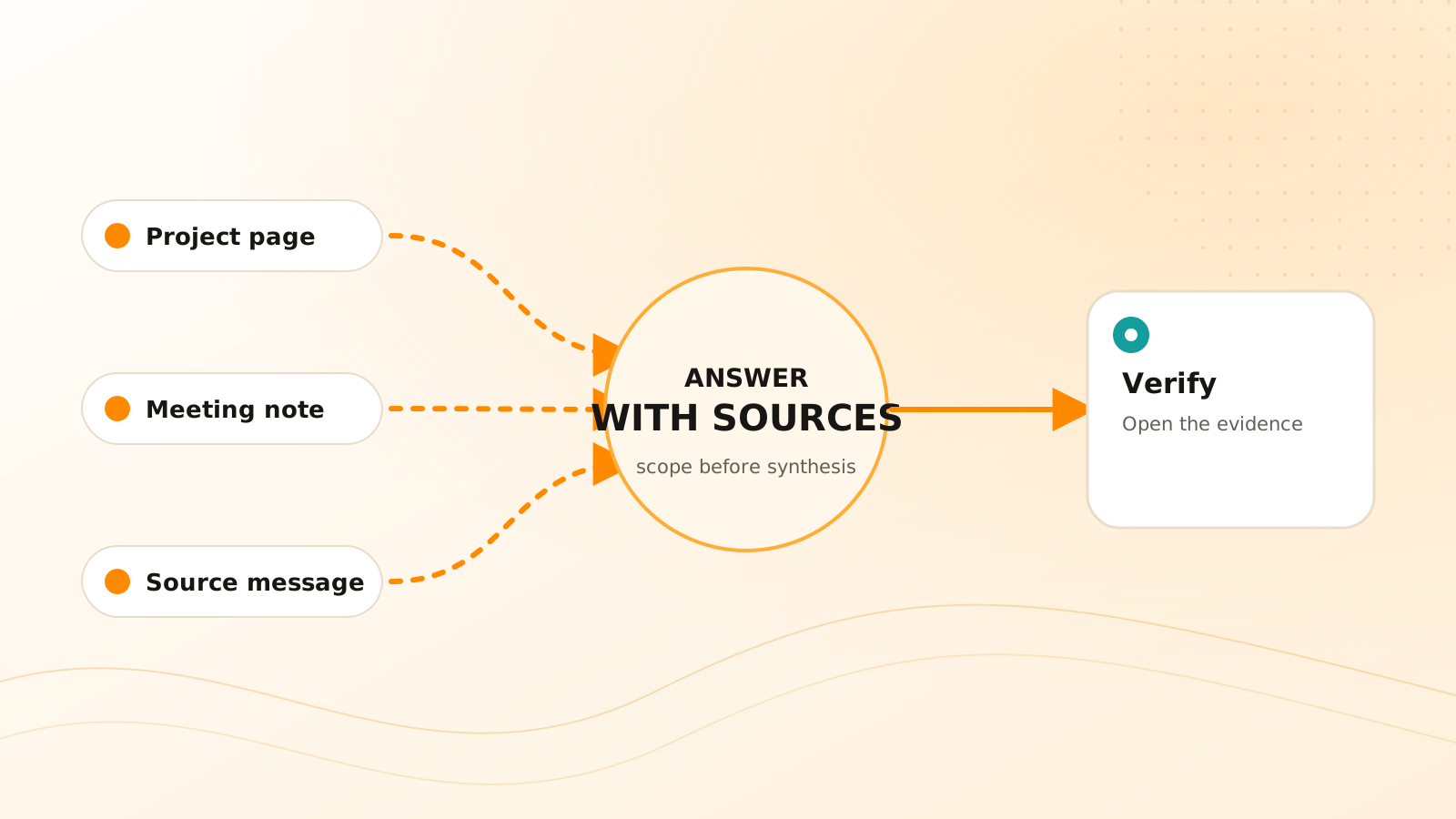
Start with enough scope to reduce ambiguity. “What were the launch decisions?” is weak when you have several launches. “For Project Atlas, what launch decisions were recorded after the July 2 review?” gives the system a project and time boundary.
Useful question patterns include:
- Decision: “What was decided, by whom, and what evidence supports it?”
- Change: “How did the plan change between the first and latest review?”
- Open issue: “Which questions remain unresolved in these project notes?”
- Commitment: “What follow-ups were explicitly assigned, and where were they recorded?”
- Synthesis: “Which themes recur across these research sources, and where do they disagree?”
Ask the system to distinguish direct evidence from interpretation. A concise “not found” is more useful than an invented completion date.
With ChatMind, make that scope concrete by specifying the Clear Tangle records, project context, or time period you want considered. A useful response should shorten the path to Captures, Pages, Tasks, Projects, tags, Memory Vault, or approved integration context—not hide them. Open the cited item before turning an answer into a Task, decision, or durable memory.
What should a source-grounded answer show?
A trustworthy answer should make it possible to inspect:
- the note, message, page, or file supporting each important claim;
- the date and project context when they affect meaning;
- whether the answer quotes, paraphrases, or infers;
- disagreement or uncertainty across sources;
- material that was excluded by the selected scope.
Provenance is not decoration. It is the relationship between a claim and the information that produced it. Even when a citation points to a real note, open it and confirm that the cited passage actually supports the sentence.
A source-first chat workflow
Ask, inspect, and act
Define the scope
Name the project, person, source type, or time period that separates this question from similar work.
Request evidence
Ask for source links and for uncertainty or disagreement to be shown explicitly.
Open the important sources
Check dates, surrounding context, and whether the answer preserved the source's level of certainty.
Refine the question
Correct the scope or terminology when retrieval mixed unrelated material.
Act on verified context
Create a task, page, or decision record only after the relevant claims have been checked.
What should you verify most carefully?
Scrutinize claims about deadlines, owners, approvals, money, legal obligations, health, security, and completed work. Also verify negative claims such as “no one raised an objection,” because absence is difficult to establish from an incomplete set of notes.
Summaries can flatten chronology. If an early note proposed an option and a later note rejected it, a combined answer may mention both without making the final decision clear. Ask for the latest dated evidence and inspect it.
How is note chat different from general chat?
A general chatbot answers from its model context and whatever you add to the conversation. A personal knowledge chat is intended to retrieve from a defined collection of your material. That makes it better suited to your projects and history, but it does not make its answers automatically correct.
The value comes from bounded context and inspectable evidence. Clear Tangle's ChatMind documentation describes the current conversation and source experience. For direct retrieval, use the preceding guide to keyword and semantic search.
Frequently asked questions
Does a citation guarantee that an AI answer is correct?
No. A citation may be irrelevant, incomplete, or interpreted incorrectly. It gives you a path to verification; you still need to check whether the source supports the claim.
Should I ask one broad question or several narrow ones?
Begin with a focused question when accuracy matters. Use broader synthesis for exploration, then narrow important conclusions to specific sources, dates, and projects.
Can I turn a chat answer directly into a task?
Only after confirming that the source contains a real commitment and that the owner, action, and date are correct. Preserve the source link with the task.
What should I do when ChatMind cannot find enough evidence?
Run a direct Search using one exact anchor such as a project name, person, date, or phrase; open the likely Capture or Page; then ask the narrower question again. If the source still does not support the claim, record it as unknown rather than asking ChatMind to infer an answer.
Should a ChatMind summary replace my original notes?
No. Keep the original records as the evidence layer and use the summary as a navigable synthesis. Return to the source whenever chronology, exact language, disagreement, or a consequential decision matters.
Conversational access should shorten the path to evidence, not replace evidence. The best note chat leaves you with a clearer answer, visible uncertainty, and a direct route back to the material that made the answer possible.
Ask your knowledge base and keep the evidence close
Use ChatMind to work with Clear Tangle context, inspect supporting sources, and turn verified information into a next step.
Explore ChatMind →Sources
- Clear Tangle Chat Documentation — supports the current ChatMind context, citation, and conversation capabilities described here.
- W3C PROV-O — World Wide Web Consortium; supports the importance of provenance relationships between information and the entities or activities that produced it.
- Artificial Intelligence Risk Management Framework Generative Artificial Intelligence Profile — National Institute of Standards and Technology; supports risk-aware evaluation of generative AI outputs and attention to confabulation and information integrity.