You remember discussing a “renewal concern,” but the note says “procurement may delay the extension.” Exact keyword search may miss it. Semantic search can recognize that the ideas are related—but it can also return material that feels similar without being the evidence you need.
Neither method is universally better. They solve different retrieval problems, and a dependable personal knowledge system should let you benefit from both.
What is keyword search?
Keyword search retrieves material by matching query terms against words stored in titles, bodies, tags, and other indexed fields. Mature systems can account for word frequency, field importance, and variations of a term, but the central signal remains textual overlap.
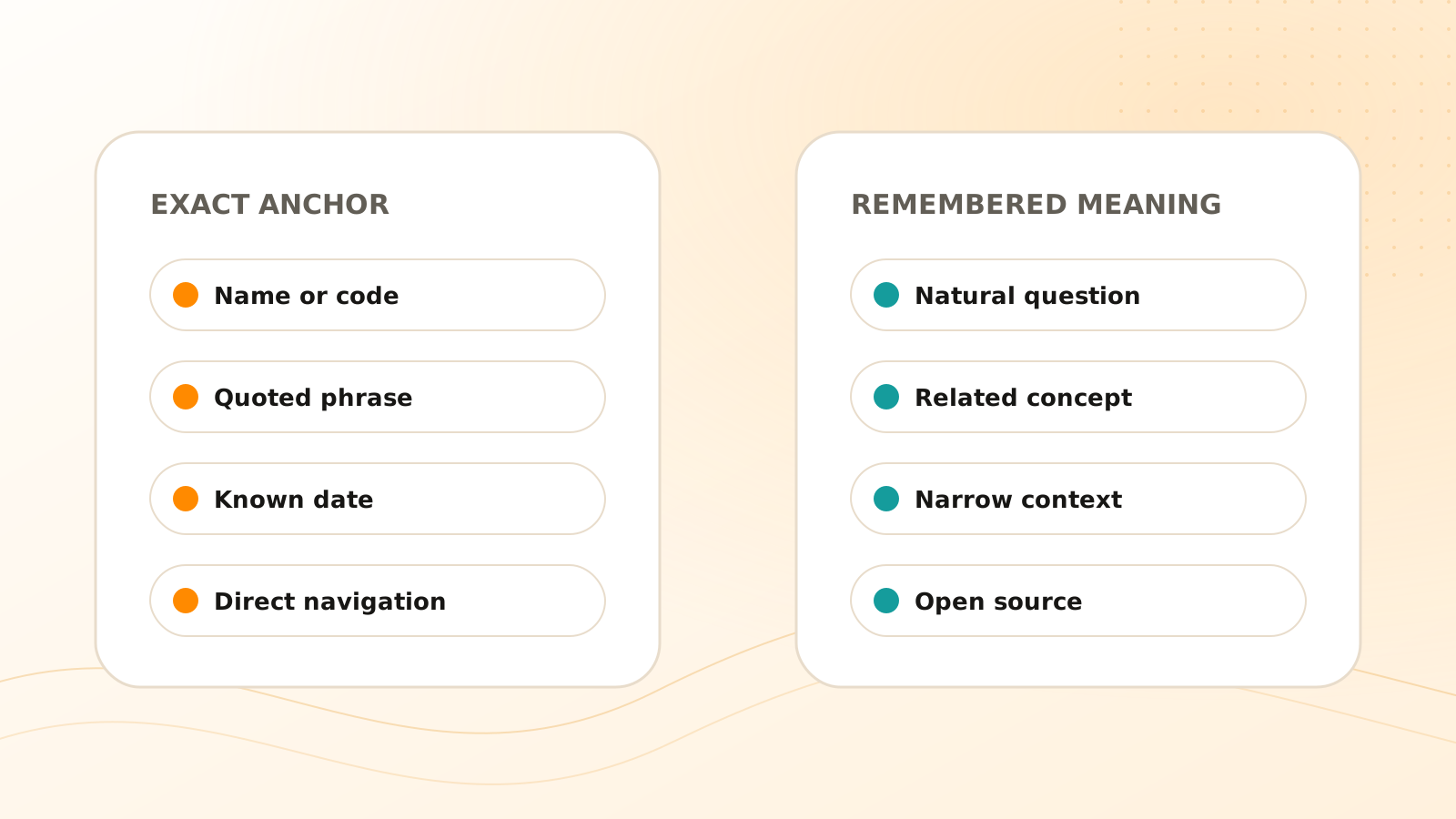
Keyword search is especially strong when you know an exact detail:
- a person's name;
- an error code;
- a product or project identifier;
- a quoted phrase;
- a date, tag, or filename;
- a distinctive term from the source.
Its main weakness is vocabulary mismatch. If your query and the saved material describe the same idea with different words, a literal search may not connect them.
What is semantic search?
Semantic search represents a query and stored content in a form that allows comparison by meaning or conceptual similarity. In modern systems, vector embeddings are a common part of this process.
This helps when you remember the idea but not the wording. A search for “customer worried about annual billing” may surface a note about “procurement requiring yearly invoicing” even when the exact words differ.
Semantic search is useful for:
- finding paraphrases and related concepts;
- recovering notes written with forgotten terminology;
- exploring themes across several projects;
- retrieving context from natural-language questions.
Its weakness is false similarity. Two passages can be conceptually close while referring to different customers, periods, decisions, or levels of certainty.
When should you use each search mode?
| YOUR SITUATION | START WITH | WHY |
|---|---|---|
| You know the exact phrase or identifier | Keyword search | Precision matters more than conceptual expansion. |
| You remember the idea but not the wording | Semantic search | Meaning can bridge different vocabulary. |
| Results mix several projects or people | Keyword plus filters | Names, dates, and project scope reduce ambiguity. |
| You are exploring a broad theme | Semantic search | Related material may reveal connections you did not name. |
| You need evidence for a decision | Either, then inspect sources | Retrieval is the beginning of verification, not the end. |
The best workflow often begins broad and narrows. Use semantic search to recover a candidate set, then apply project, source, type, or date filters. If you know a distinctive phrase, use it to verify that the result is the item you intended.
That layered approach maps directly to Clear Tangle Search: begin with the words or remembered meaning, narrow the results with project, tag, category, or date context, and open the connected Capture or Page before relying on it. ChatMind can synthesize an answer from relevant Clear Tangle context and cite saved or connected source items, but the underlying source remains the place to verify a consequential claim.
Why hybrid search is better for a second brain
Personal knowledge contains both exact anchors and fuzzy recollections. A project code should match precisely. A half-remembered meeting decision may require semantic similarity. Combining signals gives the system more ways to find the right item while preserving opportunities to control scope.
A hybrid result should still answer four questions:
- 1What source was retrieved?
- 2Why is it relevant to this query?
- 3Which person, project, or time period does it concern?
- 4Can you open the original context?
High similarity is not proof. Source access is what lets you distinguish a relevant result from a merely plausible one.
How do you improve search quality?
Preserve meaningful source text
Over-compressing every capture into a tiny summary removes the distinctive language that helps both exact and semantic retrieval. Keep the source and add a concise maintained conclusion when useful.
Add structure that reflects real work
Projects, dates, content types, people, and tags provide boundaries. They are most valuable as filters and context, not as an obligation to classify every note perfectly.
Search in layers
Start with the remembered concept. Narrow by project or date. Open the likely source. Then save or act on the verified material rather than the search snippet alone.
Correct your system
If important material is repeatedly hard to find, improve its title, connect it to the right project, or create a maintained page that captures the stable conclusion. Search quality depends partly on the quality of what you retain.
Clear Tangle's search documentation describes the current search and filtering experience. The earlier guide to choosing second-brain content can help reduce irrelevant input before retrieval becomes a problem.
Frequently asked questions
Does semantic search understand my notes like a person?
No. It estimates relationships in meaning; it does not guarantee that two items share the same factual context, intent, or truth. Inspect the source before relying on the result.
Will semantic search replace folders and tags?
Not entirely. Structure still provides useful boundaries for projects, dates, people, and sensitive contexts. Semantic retrieval reduces dependence on perfect filing, but it does not make scope irrelevant.
Which search should I try first?
Use keyword search for exact anchors and semantic search for remembered meaning. If the decision matters, combine retrieval with filters and source verification.
Can Clear Tangle search across different kinds of knowledge?
Yes. Smart Search compares a natural-language query with indexed Clear Tangle content, while the command palette supports direct navigation such as project or page lookup. Narrow broad results with available context and inspect the original item before acting.
Why did semantic search return a plausible but wrong result?
Meaning can be similar even when the customer, project, time period, or decision differs. Add scope, use exact anchors where available, and verify the source rather than trusting similarity alone.
A second brain should help when your memory is imprecise without pretending that similarity is certainty. Use both forms of search, keep the source close, and let verification—not ranking alone—decide what you trust.
Find the idea and verify the source
Use Clear Tangle search to retrieve personal knowledge by text and meaning, then return to the connected source before acting.
Explore intelligent search →Sources
- Clear Tangle Search Documentation — supports the current Clear Tangle search modes, filters, and result behavior described here.
- Introduction to Information Retrieval — Cambridge University Press and Stanford NLP Group; supports the foundational explanation of term-based retrieval and relevance.
- Efficient Estimation of Word Representations in Vector Space — Tomas Mikolov and co-authors; supports the general explanation of vector representations that capture semantic relationships.